





The demand for professional teeth whitening is increasing year by year. It’s hardly surprising: a brighter smile creates a more youthful appearance, boosts confidence, and delivers instantly noticeable results. But how exactly does it work? How long does it last? Is it safe? And which method is truly worth choosing? In the guide below, we explore everything you should know about teeth whitening — in clear, accessible language, yet with full clinical accuracy — so you can make the best possible decision without any unwelcome surprises. 
- Is it good to whiten my teeth?
- What is the best method to whiten teeth?
- How to get the best results from your whitening treatment?
Is it good to whiten my teeth?
The short answer: yes, it is effective and safe — when carried out correctly. Professional teeth whitening does not damage the enamel, does not “strip away” the surface, does not cause long-term sensitivity, and does not thin the enamel. The whitening agents used in the dental surgery release oxygen molecules, which chemically lighten the colour of the dentine. Meanwhile, the structure of the enamel remains unchanged.
However, before whitening, your dentist or dental hygienist should always:
- assess the health of the teeth and gums,
- rule out decay and periodontal disease,
- perform a professional scale and polish.
This is not just a formality. For example, if a small cervical abrasion remains untreated — something that may not be visible to the naked eye — whitening can temporarily increase sensitivity. A little preparation completely prevents this.
Can yellow teeth go white again?
In most cases, yes. “Yellow teeth” can have various causes, and the vast majority respond very well to whitening. However, restorations (crowns, veneers, fillings) cannot be whitened — only natural vital teeth can.
External discolouration:
- coffee, tea, red wine, cola,
- smoking,
- strongly coloured foods (e.g. curry, soy sauce).
In these cases, in-surgery whitening can lighten the teeth by several shades, depending on the individual. The exact number of shades cannot be predicted in advance.
Internal discolouration:
With age, the dentine gradually becomes more yellow — a completely natural process. This deeper shade can also be successfully lightened, although it may require a longer treatment period. More severe cases, such as tetracycline-related greyish discolouration, do improve with whitening, but not to perfection — these patients usually benefit from a combined, extended protocol. Non-vital teeth require a separate internal whitening procedure.
What is the best method to whiten teeth?
There is no single “best for everyone” method. The ideal approach is safe, well-planned, and tailored to your specific needs. The three main options are:
1. In-office teeth whitening
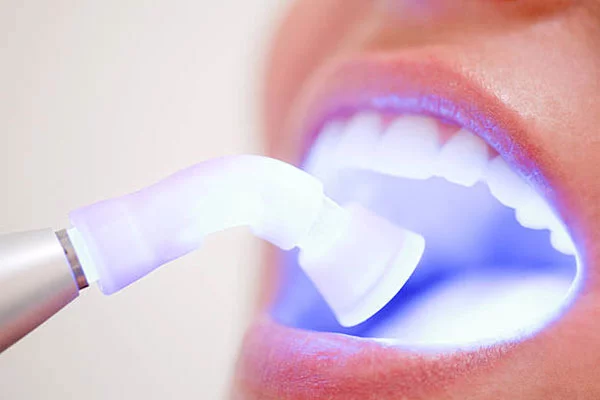 This provides the fastest and most dramatic results. A high-concentration whitening agent is used under full isolation, enabling several shades of improvement in a single visit.
2. At-home whitening (at-home, professionally supervised whitening)
Custom-fit trays are made from impressions, and you carry out the whitening at home. It is comfortable, predictable, and offers long-lasting results. Ideal if you prefer a gradual, more subtle change.
3. Over-the-counter products
Whitening strips and pens may help with minor surface staining, but they are not a substitute for professional whitening. They usually offer only optical brightening rather than true shade change. The effect tends to be superficial and short-lived, and frequent use may lead to sensitivity. Whitening toothpastes do not lighten the teeth internally — they merely abrade surface stains. With daily long-term use, they may cause sensitivity.
Do teeth go back to normal after whitening?
The results of whitening are long-lasting, but not permanent. Teeth do not “revert” suddenly, but a gradual, mild re-staining is natural over time — especially as most people continue to consume coffee, tea, wine, and other coloured foods.
Typical outcome:
- results lasting 1–2 years,
- but faster re-staining in those who drink coffee/tea frequently or who smoke.
Importantly, whitening does not damage the teeth. They do not become weaker, thinner, or permanently more sensitive.
What should we keep in mind after bleaching?
After whitening, the enamel is temporarily more porous for 24–48 hours, meaning it can absorb pigments more easily. This is completely normal and resolves quickly — but during this period, certain rules are essential.
For 5–7 days after whitening, follow a “white diet”:
- Avoid strongly coloured foods and drinks (coffee, tea, red wine, cola, curry, tomato-based dishes, soy sauce, cherries, etc.).
- Do not smoke.
- Avoid very hot or very cold foods.
- Use desensitising toothpaste or gel if needed.
- Avoid acidic drinks (lemonade, energy drinks).
Proper aftercare significantly extends the longevity of the whitening results.
How often can bleaching be applied?
This is one of the most common questions — and understandably so. Patients often worry whether it’s possible to “over-whiten” the teeth. The good news: professionally supervised whitening is safe and repeatable.
General recommendations:
- Full whitening treatment: once every 1–2 years.
- Maintenance “top-up” whitening: 1–2 short home applications per year.
The frequency of re-whitening is not limited by safety, but by your personal aesthetic preference — that is, when you feel you’d like your teeth refreshed again. Your dentist or hygienist will help determine the ideal timing.
How to get the best results from your whitening treatment?
- Always start with a check-up.
- Choose a method that feels comfortable and safe for you.
- Follow all aftercare instructions.
- Have an annual review to see whether a refresh is needed.
Professional in-surgery whitening is a fast, safe and gentle treatment with impressive results. If your oral hygiene is good, you attend regular hygiene appointments, and follow aftercare guidelines, you can enjoy a bright, natural-looking smile for many years.
