





If you are considering the placement of a dental implant, you have probably already asked yourself the question: “How long does the entire process take?” There is no need to worry — this is not a complicated or obscure procedure. In this article, we explain everything clearly, simply, and with clinical accuracy.
In this article you will find answers to the following:
- How many appointments are required for a dental implant?
- How long should you wait between tooth extraction and implant placement?
- What does the 3/2 rule mean in dental implantology?
- When is it too late for a dental implant?
- Which hurts more: tooth extraction or implant placement?
- Practical tips for faster healing and long-term implant success
How many appointments are required for a dental implant?
Dental implant treatment is not a quick “walk-in and done” procedure. It usually consists of several stages, and the duration of dental implant treatment largely depends on the condition of the bone, the patient’s general health, and the technique used.
Typically, the treatment includes the following steps:
- Initial consultation: Clinical assessment, X-rays, CT scan, and treatment planning.
- Tooth extraction (if required): Removal of the damaged tooth if it has not already been extracted.
- Bone grafting/sinus lift (if required): Performed when the available bone volume is insufficient to ensure implant stability.
- Implant placement: The surgical phase, usually carried out under local anaesthesia.
- Healing period: Integration of the implant with the bone (osseointegration), typically lasting 3–6 months*.
- Placement of the crown or bridge: Once the implant is stable, the final restoration is fabricated and fitted.
Overall, patients usually require 3–6 appointments, and the full treatment timeline may extend to 6–9 months, depending on the factors outlined above.* The waiting period depends on infection, bone quality, and primary stability. Immediate placement is an exception, not the rule. In standard single-tooth implant cases, the full treatment timeline usually ranges from 6 to 9 months. In contrast, advanced techniques such as All-on-4 or immediate loading protocols may significantly shorten the functional tooth replacement phase, while still requiring a healing period for final restoration.
The timeline of immediate implant loading
The timeline of immediate loading of dental implants is particularly appealing to patients seeking a fast solution that can be clinically safe in carefully selected cases. With this technique, a temporary restoration is placed on the implant within a short timeframe — often within 24–72 hours following implant placement. It is important to note, however, that immediate loading is not suitable for every patient and requires strict clinical criteria to be met.
The timeline of All-on-4 implant treatment
All-on-4 is one of the most common clinical applications of immediate loading. One of the main advantages of All-on-4 implant treatment is its predictable and relatively short treatment time. In many cases, the timeline of All-on-4 dental implants begins with the initial consultation, followed by tooth extraction, implant placement, and the fitting of a temporary fixed prosthesis — often within a single day. The final prosthesis is typically fitted after 3–6 months, once full osseointegration has occurred. This approach is ideal for patients who wish to avoid extended periods without teeth.
How long should you wait between tooth extraction and implant placement?
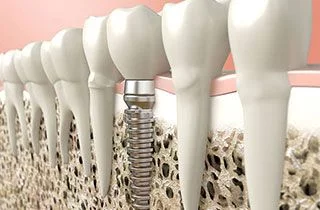
This is a common and very reasonable question: when can an implant be placed after tooth extraction? While the answer is not always straightforward, a useful guideline is that we usually wait 2–6 months to allow proper healing. This ensures that the bone is sufficiently stable to support an implant. In cases of immediate implant placement or All-on-4 treatment, the implant can be inserted at the same time as the extraction. This approach is convenient, but only recommended in selected cases — for example, when the bone is healthy and free of infection.
How long will I be without teeth during implant treatment?
No one wants to spend weeks or months without teeth. Fortunately, temporary solutions such as removable dentures or temporary bridges are available. These allow you to receive a provisional tooth replacement immediately, so you can continue smiling and chewing comfortably during the healing period.
Can I receive a dental implant six months after tooth extraction?
The short answer is yes. After six months, implant placement is generally safe, as the bone has usually healed and stabilised by this time. For long-term success, however, it is essential that excessive bone resorption has not occurred and that the surrounding gum tissue is healthy.
What does the 3/2 rule mean in dental implantology?
The so-called 3/2 rule is a commonly used clinical guideline rather than a strict protocol: the vertical bone height should be at least 2 mm greater than the length of the implant, and the horizontal bone width should be at least 3 mm wider than the implant diameter. This helps ensure primary stability and minimises the risk of complications. Simple, but extremely valuable — especially when aiming for long-term implant success.
When is it too late for a dental implant?
With long-standing tooth loss, some degree of bone resorption is expected. However, “too late” is rarely the case. Thanks to modern bone augmentation techniques, implant placement is often still possible even after a significant time has passed. The key message is simple: the sooner treatment begins, the more straightforward it usually is.
Which hurts more: tooth extraction or implant placement?
This question comes up frequently — and understandably so. In reality, both procedures are performed under comparable local anesthesia, meaning discomfort is minimal. In fact, many patients report that implant placement is less uncomfortable than tooth extraction, as modern techniques and minimally invasive surgical approaches are used. Any post-operative discomfort is generally mild and easily managed with standard pain relief. So, there is no need to worry. The procedure itself is painless due to anesthesia, while mild post-operative discomfort is normal.
Practical tips for faster healing and long-term implant success
- Oral hygiene: Thorough yet gentle brushing around the implant area.
- Regular follow-ups: Professional check-ups at least every six months.
- Avoid smoking: Nicotine significantly slows bone healing.
- Healthy lifestyle: A nutrient-rich diet and adequate hydration.
It is important to understand that the waiting period is not wasted time. Every single week is necessary to ensure that the implant is not merely placed, but functions reliably for decades. This is what distinguishes temporary solutions from truly long-lasting tooth replacement. When you understand the implant timeline realistically, there are no surprises. You know what happens — and when. And perhaps most importantly, you can begin treatment calmly and with confidence. Successful implant treatment is based on careful planning, precise execution, and adequate healing time. And it is planned for the long term — just like we are. Visit our dental implants before and after, dental implants costs, or all on 4 dental implants cost abroad page.
